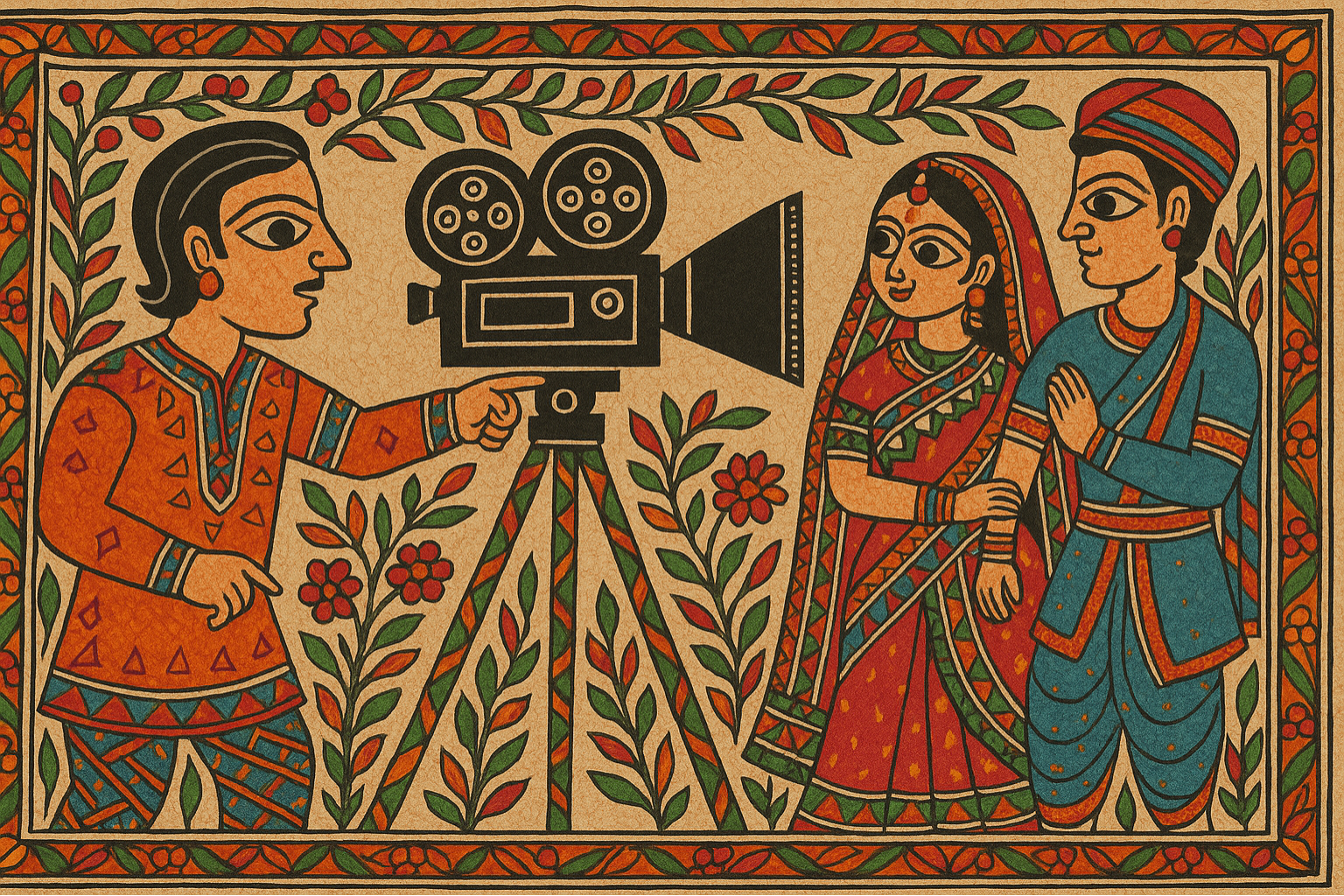
To many outside the state, the phrase “regional movies from Bihar” or “cinema of Bihar” might sound unfamiliar or even insignificant. There’s a common misconception that the state lacks a meaningful film industry — that its contributions are either negligible or unworthy of attention. But is this really the case? Are Bihar’s regional films truly in crisis, slowly fading into obscurity?
Many millennials hailing from Bihar and working in different corners of the country are gradually losing touch with their roots — their cultural identity, heritage, and native languages. Look around — how many of us genuinely take pride in calling ourselves “Bihari”? The reality is disheartening. Our mother tongues — Bhojpuri, Magahi, Maithili — have been slipping away for generations. Traditions are now mostly confined to occasional family gatherings or festivals like Chhath, which temporarily draw us back home.
The same unfortunate trend can be seen in Bihar’s regional cinema. Once rooted in cultural richness, these films are now overshadowed by a wave of vulgarity and superficiality. Even when filmmakers choose to bring Bihari stories to the screen, many opt for Hindi translations instead of embracing the original dialects.
Ask around — how many critically acclaimed Bhojpuri, Magahi, or Maithili films can people name? Very few, if any. And if someone does mention a film or two, chances are it’s from the ₹2,000 crore Bhojpuri industry — often associated with sensationalism and crass content, rather than art or authenticity. But has it always been like this?
India has come a long way since its independence in 1947, and so has its cinema. From the era of silent films like Raja Harishchandra (1913) to the advent of talkies with Alam Ara in 1931, the Hindi film industry flourished. The 1950s saw the rise of cinematic legends like Satyajit Ray, Bimal Roy, and Chetan Anand. But one must wonder — when did this cinematic wave reach Bihar? And how many regional films from Bihar have truly made a mark on the national stage?
The History of Movies from Bihar
The roots of regional cinema in Bihar run deeper than many realize. As early as 1902, Jamshedji Framji Madan — a pioneering figure in Indian film and theatre — acquired the Elphinstone Theatre Company in Bombay and later expanded its reach. One of the offshoots was the Elphinstone Theatre in Patna, which was eventually converted into the Elphinstone Cinema. This venue became a hub for screening silent films, the first of which was Punarjanam, shown in 1931.
A new chapter in Bihari cinema began in the 1960s with the release of Ganga Maiya Tohe Piyari Chadhaibo — the first-ever Bhojpuri film. Starring Kumkum, Nazir Hussain, and Ashim Kumar, the film premiered in Veena Cinema, Patna, in 1963. It was released at the personal request of Dr. Rajendra Prasad, India’s first President and a proud Bihari. Since the 1980s, Bhojpuri cinema has carved a solid space for itself, although films in other regional dialects like Maithili, Magahi, and Angika have remained on the periphery.
Today, the Bhojpuri film industry is a ₹2,000 crore business — yet only a handful of its films are considered quality cinema. Many productions rely on exaggerated storytelling, flashy item numbers, and sensational titles to draw crowds. This dilution of content is particularly disheartening when compared to the cinematic progress seen in other regional industries like those in West Bengal or Kerala. While they flourish and gain national and international recognition, Bihar’s regional films largely remain confined to local theatres.
Still, there’s a glimmer of hope.
A new wave of filmmakers, actors, and digital creators are working to redefine the narrative. Young talent, supported by online platforms and a growing audience of proud Biharis, are slowly reshaping the regional film landscape. Among the frontrunners in this revival are actress Neetu Chandra and her brother Nitin Chandra. Together, they’ve taken on the mission of promoting Bihar’s rich culture and language through meaningful cinema.
Under their banner Champaran Talkies, the duo has produced several acclaimed works including Deswa and Mithila Makhaan, as well as numerous short films available on YouTube. They’re also beloved for their annual Chhath videos — a heartfelt series that has gained massive online viewership since 2016. In interviews, Nitin has shared touching stories of people reconnecting with the tradition of Chhath in their homes after watching his videos.
Their efforts are not just about films — they’re about identity, pride, and a deep-rooted cultural revival.
Bringing regional films from Bihar into the national and global spotlight is no easy feat. Despite the growing talent and strong storytelling, filmmakers from the state continue to face major hurdles — from limited funding to a lack of interest from mainstream streaming giants like Netflix, Hotstar, and Amazon Prime.
During a live session hosted on the Facebook page of Bejod, The Eastern Roots (formerly The Ranchi Review) reached out to filmmaker Nitin Chandra, asking him about the long-awaited release of Mithila Makhaan. His response revealed the harsh realities of regional cinema — even Deswa, one of his earlier films, never made it to theatres. It remained confined to a few special screenings, unable to find the kind of platform it deserved.
What’s even more disheartening is that these films often fail to attract distributors and platforms simply because they don’t conform to the so-called “commercial” formula — lacking the sensationalism or obscenity that some Bhojpuri films have unfortunately come to be known for. Yet, despite the odds, Champaran Talkies continues to push forward. In a major step, they’ve announced plans to release the National Award-winning Mithila Makhaan on their very own online streaming platform later this year.
There’s also hope rising in the form of young filmmakers like Achal Mishra, who is making waves with visually stunning, story-driven films in Maithili. From working as an assistant director on Talvar (2015) to creating powerful independent short films based in rural Bihar, Mishra has shown a rare blend of cinematic sensitivity and regional pride.
His critically acclaimed film Gamak Ghar was nominated for the Golden Gateway of India Best Film at the 2019 Mumbai Film Festival. The movie is a poignant, poetic reflection of generational change in a rural Bihari household, told through immersive visuals and minimal dialogue. His other short films — A Winter Afternoon, Bipin Chaudhary’s Lapse of Memory, and Kafan — are all worth exploring, especially for those rediscovering cinema during the quiet moments of the COVID-19 lockdown.
These filmmakers, through their courage and commitment, are slowly chipping away at the walls of stereotype and neglect that have long surrounded regional cinema from Bihar. As Nitin Chandra powerfully put it during his interaction with The Ranchi Review, “To change the market, we need to create a brand new one.”
And that’s exactly what they’re doing — creating a new market, a new language of storytelling, and a new sense of pride in Bihar’s cultural identity. These efforts deserve not just recognition, but celebration.
(Article originally published by The Ranchi Review and on Youth Ki Aawaz by Abhinav Pathak)