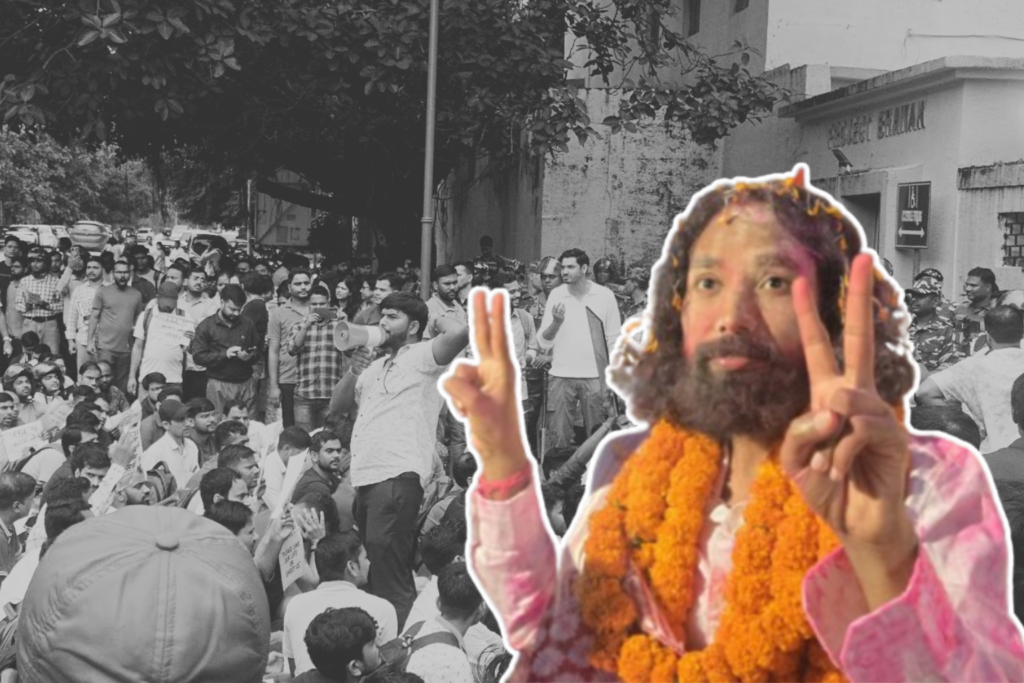
For thousands of government-job aspirants in Jharkhand, competitive examinations are more than tests—they are a route to financial stability and a secure future. In 2026, growing allegations of irregularities in recruitment examinations turned that anxiety into a statewide student movement. At the centre of the agitation emerged Devendra Nath Mahto, a student leader from Ranchi whose hunger strike became one of the defining moments of the protest.
Mahto, 33, has been associated with student activism since 2015. Over the years, he has raised issues related to scholarships, recruitment rules, reservation policies, alleged paper leaks and examinations conducted by the Jharkhand Public Service Commission (JPSC) and Jharkhand Staff Selection Commission (JSSC). He also entered electoral politics, contesting the 2024 Lok Sabha election from Ranchi as an Independent candidate and later the Silli Assembly seat on a Jharkhand Loktantrik Krantikari Morcha (JLKM) ticket.
His latest campaign, however, was rooted in the concerns of job aspirants.
स्वास्थ्य में गिरावट… संघर्ष जारी
— Devendra Nath Mahto (@DevendraNathMa9) August 9, 2026
लगातार मेडिकल टीम की निगरानी में स्वास्थ्य की जांच की जा रही है।
वर्तमान आंदोलन की चिंगारी 2 जुलाई को 14वीं JPSC सिविल सेवा प्रारंभिक परीक्षा के परीक्षाफल में कथित धांधली के विरोध से शुरू हुई।
5 जुलाई से निरंतर संघर्ष…
25 जुलाई से दिवा-रात्रि… pic.twitter.com/sGxIrO6OyX
The current agitation began on July 29, 2026, when candidates began a sit-in at Ranchi’s Jaipal Singh Munda Stadium over alleged irregularities in recruitment examinations. Their demands included cancellation of the 14th JPSC Preliminary Examination, an independent investigation and greater transparency in the recruitment process.
On August 2, Mahto began an indefinite hunger strike, escalating the pressure on the government. The protest subsequently grew, with students announcing a Tiranga March and a planned Assembly gherao.
The biggest confrontation came on August 10, when protesters marched towards the Jharkhand Assembly. Police used tear gas, water cannons and lathi-charge to disperse the demonstrators. Mahto, whose health had deteriorated after days without food, joined the march in an ambulance and was later admitted to Sadar Hospital in Ranchi.
The agitation also coincided with a widening investigation into alleged examination irregularities. The Jharkhand CID questioned and arrested officials connected with the controversy, including former JPSC chairperson L. Khiangte. A major point of contention was the role of TSR Data Processing Private Limited (TDPL), an IT company that had been blacklisted in 2024 but was involved in conducting examinations.
The movement eventually forced a series of government decisions. On August 17, the Jharkhand government agreed to cancel the JSSC-CGL examination and examinations conducted by TDPL since 2014. It also announced a committee to recommend reforms to the state’s examination system. Mahto ended his 16-day hunger strike following the decision.
But the story did not end there.
On August 19, the protest was temporarily suspended for two months to give the government time to act on its assurances. The following day, however, the Jharkhand High Court stayed the cancellation of several examinations, including the 11th to 13th JPSC examinations. The court subsequently stayed the cancellation of the JSSC-CGL and CDPO examinations as well.
Mahto has since indicated that the agitation is entering another phase, with a focus on reforming the recruitment system rather than simply cancelling individual examinations.
For Mahto, therefore, the 2026 protest represents more than one examination or one political moment. It has become a larger fight over trust, transparency and accountability in Jharkhand’s recruitment system—with thousands of aspirants watching what happens next.