


Long before it entered global heritage conversations, Santiniketan was just dry red earth outside Bolpur. This is in West Bengal’s Birbhum district. Its story has two beginnings. One belongs to a father in search of solitude. The other belongs to a son determined to reinvent what a school could be.
A Father’s Retreat
In 1862, Debendranath Tagore was travelling by boat toward Raipur. He came upon a landscape of red soil and open paddy fields. It struck him deeply. He decided to establish an ashram on the spot. The following year, he formally acquired twenty bighas of land. It came from Bhuban Mohan Sinha, the landlord of Raipur. He named the place Santiniketan — the abode of peace. He built a retreat there for householders. It was meant for those seeking time away from worldly life, for prayer and reflection.
The area itself carried an unlikely past. It had originally been known as Bhubandanga. The place was notorious for dacoits. Debendranath persuaded them to give up crime. They helped him develop the land instead. In 1888, he drew up a trust deed for the ashram. It dedicated the space to worship without idols, open to devotees of the formless divine. A few years later, in 1891, an iron-framed prayer hall went up on the grounds. It had stained glass and was called the Upasana Mandir. Its design is said to have drawn inspiration from London’s Crystal Palace. A fair held on its fifth anniversary in 1895 grew over time. It became the Poush Mela, still celebrated today.
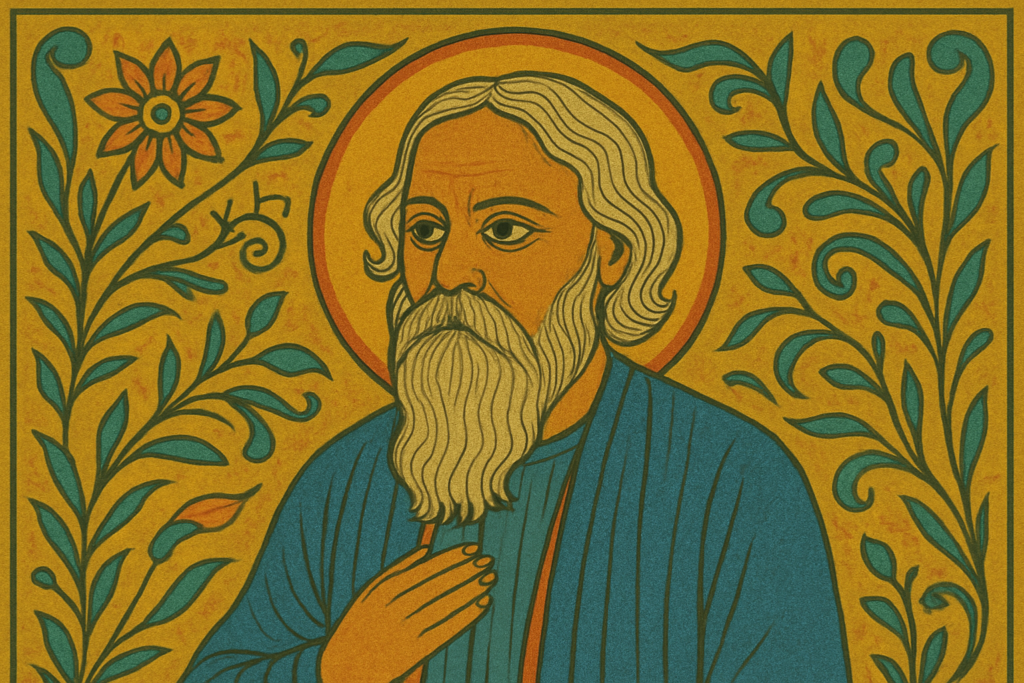
Tagore’s Experiment
Rabindranath Tagore grew up partly in the shadow of this retreat. But it was only as an adult that he made it his own. He spent roughly a decade managing the family’s estates at Shilaidaha, along the Padma river. Those years brought him close to the realities of rural life. He returned to Santiniketan determined to build something for the wider society around him.
On 22 December 1901, Tagore opened the Brahmacharyashrama. It was a residential school with no more than five pupils. One of them was his own son. The idea borrowed from the ancient gurukul model. Teacher and student shared a single life and held classes in the open air. It stood as a deliberate departure from British-style schooling, which dominated India at the time. In 1925, the school took the name it still carries today: Patha Bhavana.
The institution grew quickly in the years that followed. Kala Bhavana, the art school, was founded in 1919. Sangit Bhavana, devoted to music and dance, began within it. It became a separate department in 1933. In 1921, Tagore widened his ambitions further. He founded Visva-Bharati University. The name means, roughly, “where the world makes a home in a single nest.” He wanted it to be a meeting ground between East and West. It was meant to be a centre where Asian cultures could draw closer together. Decades later, in 1951, Visva-Bharati became a central university. This happened through an Act of Parliament, four years after India’s independence.
Building Without Borrowing
What set Santiniketan apart wasn’t only its teaching philosophy. Its physical form mattered just as much. Colonial and European styles dominated institutional architecture in India at the time. The campus took a different route entirely. It drew on indigenous materials and folk traditions. It borrowed influences from across Asia rather than the West. This has since been described as an early expression of pan-Asian modernism. Tagore himself went on to build five houses on the grounds. He named them Uttarayan, Udayan, Udeechi, Shyamali, and Punashcha. Each one was an experiment in form as much as in dwelling.
A Long Wait for Recognition
The campaign for UNESCO World Heritage status stretched across more than a decade. Efforts to secure Santiniketan’s place on the list began in 2010. A fresh push started around the 2020–21 financial year. It was backed partly by restoration work on several structures. The Archaeological Survey of India carried out that work. India’s Culture Ministry made the case to UNESCO directly. It argued that Santiniketan represented a significant exchange of human values. The site had shaped architecture, town planning, and landscape design. It had also shaped the arts within a culturally important region. The persistence paid off. Santiniketan was eventually inscribed on UNESCO’s World Heritage List. Many connected to the site felt the recognition was overdue. Its place in India’s cultural and intellectual history is singular.
What It Still Represents
More than 160 years after Debendranath first arrived, Santiniketan remains difficult to categorise. It is part ashram, part university town, part architectural experiment. It is also a living memorial to one family’s unusual convictions. Those convictions were about education, faith, and the meeting of cultures. Its founding wasn’t the product of a single grand plan. It came from two generations layering their own ideas onto the same patch of red earth. One sought peace. The other sought to remake how a mind could be taught to think.
Read More Historical Archives here