
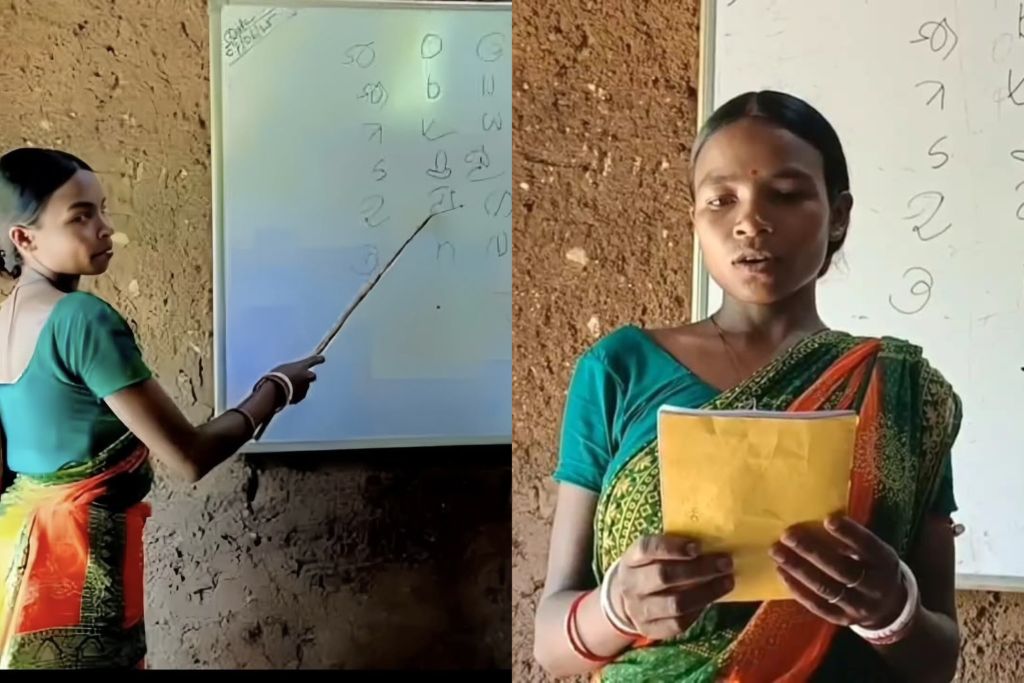
India is a land of unsung heroes. Not all of them make the headlines or win awards, yet they transform lives quietly and powerfully. One such extraordinary individual is Malti Murmu, a woman from the Santhal community of West Bengal, whose dedication to education has turned her into a symbol of hope for her village and beyond. Her story proves that change doesn’t always begin in classrooms or institutions—it often starts under the shade of a tree, in the heart of a small village, with nothing more than courage and compassion.
The story begins in Jilingsereng, a small Santhal village in West Bengal. Like many other villages in India, Jilingsereng struggled with limited access to education. Schools were few and far away, resources were scarce, and most children were expected to help with household or agricultural work rather than attend classes. For many families, education was a distant dream.
But Malti Murmu couldn’t watch in silence. She knew the value of learning and realized that the children in her community deserved the same opportunities as anyone else. Without a degree, without a salary, and without even a proper classroom, she took the first step. Gathering a few children under the shade of a tree, armed with only a blackboard and a handful of books, she began teaching. That moment laid the foundation for what would become a movement in her village.
What makes Malti’s journey remarkable is her selflessness. She does not hold a formal teaching degree, yet she teaches her students in Santhali, Bengali, and English—languages that open the doors of both heritage and opportunity. Today, she educates around 45 children who eagerly gather around her makeshift classroom.
Her day is not easy. Like most women in rural India, Malti carries the dual responsibility of managing household chores and raising her own children. Yet she carves out time, energy, and patience to nurture the minds of young learners in her village. For her, teaching is not just an activity; it is a mission. She believes that no child should be denied the light of education, no matter how difficult the circumstances.
As days turned into months, Malti’s dedication began to touch the hearts of those around her. Villagers who once saw little value in schooling slowly started recognizing her efforts. Some began donating old notebooks, pencils, and storybooks. Others helped by spreading the word and encouraging more children to attend.
Her husband, a daily wage laborer, also became one of her strongest supporters. Though his earnings are modest, he stands by Malti’s mission wholeheartedly, showing that true partnerships are built not only on shared responsibilities but also on shared dreams.
What started as a one-woman initiative under a tree gradually grew into a community-driven effort. Today, her open-air classroom is not just a place of learning but also a symbol of resilience, hope, and progress.
The impact of Malti Murmu’s work is not limited to her own village. Neighboring communities are now beginning to realize the importance of education. Parents who once sent their children to work in fields are now sending them to Malti’s classes. In a region where illiteracy has long held communities back, her efforts are planting the seeds of transformation.
Her story shows that it takes just one determined person to spark change. Education is not merely about reading and writing—it is about empowerment, dignity, and the chance to break free from the cycle of poverty. By teaching children under a tree, Malti is not only educating them but also rewriting the narrative of her entire community.
Malti Murmu is not just a teacher. She is a visionary, a community leader, and above all, a torchbearer of hope. Her journey reminds us that heroes don’t always hold titles or positions of power. Sometimes, they are ordinary women in villages who carry extraordinary determination.
Her story also raises an important question for us all: How many more Malti Murmus are hidden in the corners of our country? And what can we do to support and amplify their efforts?
India needs more changemakers like Malti—people who believe that education is not a privilege but a right. As her story spreads, it will hopefully inspire many others to step forward, take responsibility, and make a difference in their own ways.
In a world where we often look for role models in celebrities and leaders, stories like that of Malti Murmu remind us that real change begins at the grassroots. She may not have a degree or a formal institution, but she has something far more powerful—faith in the transformative power of education.
Her classroom under the tree is not just shaping the future of 45 children—it is shaping the future of an entire community. And that is what makes Malti Murmu a true beacon of hope in rural Bengal.